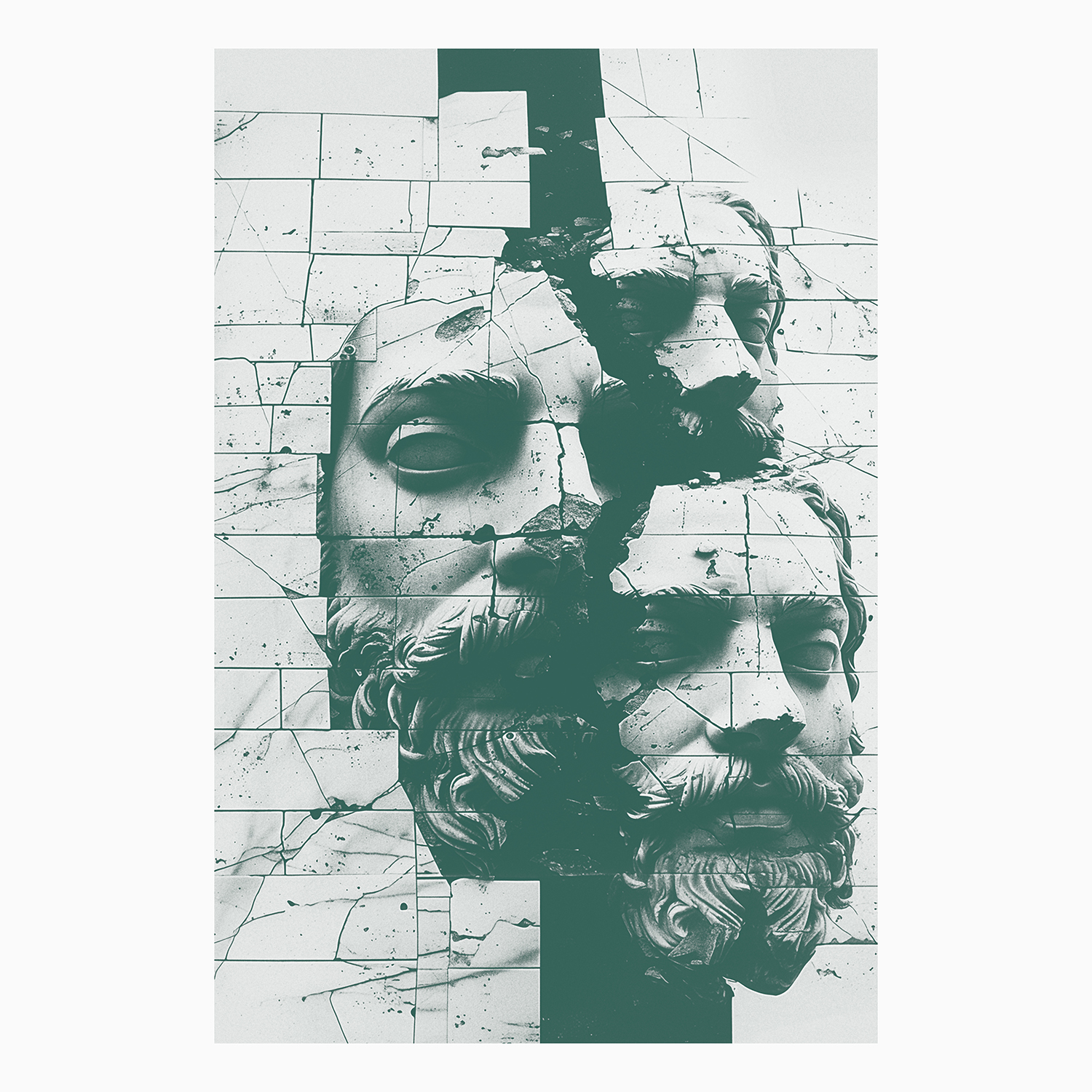
The legend of Theseus, who saved Athens’ children from the Minotaur, led to a commemorative pilgrimage involving the ship of Theseus, sparking a philosophical paradox: when does a ship, repaired piece by piece, cease to be the same entity?
On my last album, I utilized the myth of Theseus’ ship as an ontological framework to tease at the nuances of sameness. Reality is elastic; it is a multifaceted composition that can be observed and interpreted, and altered, in an innumerable number of ways. The identity of an object or a moment is flexible, partially dependent on how it is perceived. And yet, because of my partial color blindness, dyslexia, and tinnitus, I can’t trust my own perception. There’s no real way to know how great the disparity is between my observed experiences and those of another. It is plausible then to suggest that there is no clear limit of how many pieces of our shared reality can be removed before it stops being just that.
On The Voices of Theseus, I sought to further complicate this framework. First I invited artists Madeleine Cocolas, Lawrence English, FAX, and Bana Haffar to remix tracks from the album, challenging the boundaries of authenticity, identity, and transformation. While these artists were working on their remixes I had the opportunity to perform this body of work with a number of live vocalists, the last of which was G. Brenner. Our performance pulled me so far outside my comfort zone, that I felt this experience should not be limited to performance alone. It was this desire that led to me inviting G. Brenner to the studio to record new versions of four tracks from the album.
Together these eight pieces create an alternate rendering of The Voice of Theseus, through different sets of eyes, ears, and perceptual differences. The Voices of Theseus invites listeners to question how these collaborators, and own their unique perceptions, might diverge from others’ highlighting the indeterminate nature of reality and the inherent uncertainty in shared experiences.
Track Listing
- Traversing the Substrate feat. G. Brenner
- Seeing Light Without Knowing Darkness (Lawrence English Remix)
- Super Coherent Light feat. G. Brenner
- Patterned Behavior (FAX Remix)
- Seeing Light Without Knowing Darkness feat. G. Brenner
- Patterned Behavior (Bana Haffar Remix)
- We Went out, Not with a Whimper, but a Whisper… (Madeleine Cocolas Remix)
- We Went out, Not with a Whimper, but a Whisper… feat. G. Brenner
Credits
- Vocal samples by Gabriel Brenner and Dorian Wood.
- Vocals on tracks on 1, 3, 5, and 8 by Gabriel Brenner.
- Cover image by Joel Westendorf.
- Mastered by Lawrence English at Negative Space.
-
[01]
Best of 2024 Lists
Adventurous Music: Favorite Albums of 2024 -
[02]
Le atmosfere create dall’artista losangelino e le problematiche che affronta sono sempre le stesse: nenie melanconiche che invitano a riflettere sul senso del tempo e dell’identità. Questa volta, partendo dalla nave di Teseo, Novak si domanda cosa possa essere oggi una barca che salva dei bambini da situazioni mostruose (Minotauro) di pericolo e fino a quando una tale barca rimane tale, fino a prestarsi a fraintendimenti. Il punto di partenza è molto personale: l’artista non può fidarsi della sua sensibilità fallace (soffre di acufene, dislessia e daltonismo) e, quindi, il suo approccio alle cose è complesso e differenziato. Nel progetto musicale ciò si esprime nella collaborazione con altri artisti (Madeleine Cocolas, Lawrence English, FAX, Bana Haffar) a cui ha chiesto di remixare i brani e con G. Brenner che presta la voce. Ne escono fuori dei pezzi da Dead Can Dance pacati, in cui la dimensione ritmica tribale si è dissolta in ambient o in leggeri sussulti ritmici electro.
— Girolamo Dal Maso, Blow Up -
[03]
Prenant comme point de départ son précédent album, The Voice of Theseus, Yann Novak a demandé à quatre artistes, Lawrence English, Madeleine Cocolas, FAX et Bana, d’en remixer quatre titres. Parallèlement il a enregistré de nouvelles versions de The Voice of Theseus avec le chanteur Gabriel Brenner. L’ envie est survenue suite à l’interprétation live de ses oeuvres avec ce dernier.
The Voices of Theseus est une version alternative de l’album de référence, qui soulève la question de l’authencticité et de l’origine, de la création première et de son évolution vers autre chose à travers l’assemblage de matériaux communs mais habités d’énergies et d’envies nouvelles, pour composer un ensemble de titres aux frontières connectées entre elles tout en étant floutées.
Yann Novak brouille les pistes et efface les liants, ouvre les portes à quelque chose de métaphysique qui résonne de manière profonde avec le souvenir que celui-ci laisse avant dêtre brouillé par l’apport d’informations nouvelles, bribes de traces à moitié enfouies dans les méandres d’une reconstruction permanente, étroitement liée à de nouvelles envies en forme de quête permanente. Très fortement recommandé.
— Roland Torres, SilenceAndSound -
[04]
In the vast sea of ambient and experimental music, Yann Novak has always managed to craft islands of introspection that invite listeners to question their perceptions and the very nature of reality. With “The Voices of Theseus”, Novak doesn’t just build an island; he constructs a shifting archipelago that challenges our understanding of identity through sound, collaboration, and reinterpretation.
Drawing inspiration from the philosophical paradox of the Ship of Theseus—a thought experiment questioning whether an object that has had all its components replaced remains fundamentally the same—Novak embarks on an ambitious sonic journey. He deconstructs and reconstructs his previous works with the help of a cadre of talented collaborators, including Madeleine Cocolas, Lawrence English, FAX, Bana Haffar, and vocalist G. Brenner. The result is an album that is as thought-provoking as it is emotionally resonant, though not without its navigational challenges.
The opener, “Traversing the Substrate feat. G. Brenner”, sets the stage with a delicate interplay between Brenner’s haunting vocals and Novak’s textured soundscapes. The track unfolds slowly, like a fog lifting over a forgotten landscape, revealing layers of melancholy and subtle dissonance. Brenner’s voice acts as both guide and specter, leading us through Novak’s meticulously crafted auditory terrain. The use of sparse instrumentation allows each note and whisper to resonate, creating an intimate atmosphere that feels both personal and otherworldly.
Lawrence English’s remix of “Seeing Light Without Knowing Darkness” follows, introducing a denser, more immersive experience. English, a master of deep listening, enriches the original composition by adding layers of granular synthesis and low-frequency drones that envelop the listener. The track maintains Novak’s contemplative mood but pushes it into a more expansive realm, suggesting the boundlessness of perception and the infinite ways reality can be interpreted. It’s a respectful reimagining that retains the core essence while offering a fresh perspective—a testament to the album’s overarching theme.
“Super Coherent Light feat. G. Brenner” brings us back to the Novak-Brenner collaboration, this time exploring a more turbulent emotional landscape. Brenner’s vocals are layered and processed, creating a chorus of voices that echo the multiplicity of the self. The soundscape beneath shifts between soothing ambient textures and abrupt, glitch-like interruptions, symbolizing the fragility and instability of identity. It’s a challenging listen, demanding active engagement from the audience, but rewards with a profound sense of connection and understanding.
FAX’s remix of “Patterned Behavior” introduces a rhythmic element that had been subtly absent until now. The beats are understated yet insistent, providing a structure that contrasts with Novak’s typically amorphous compositions. This track injects a sense of urgency and movement, perhaps alluding to the relentless march of time and change that underpins the Ship of Theseus paradox. FAX manages to respect the original material while imprinting his own stylistic signature, resulting in a piece that feels both familiar and refreshingly new.
“Seeing Light Without Knowing Darkness feat. G. Brenner” offers a more subdued and introspective take compared to its earlier remix counterpart. Here, Brenner’s vocals are front and center, conveying a vulnerability that is both touching and unsettling. Novak’s minimalist accompaniment serves to highlight the emotional weight carried by the vocals, creating a space where silence and sound coexist in a delicate balance. It’s in these moments that the album’s emotional depth truly shines through, inviting listeners to reflect on their own experiences of change and continuity.
Bana Haffar’s remix of “Patterned Behavior” takes a more experimental route, deconstructing the original track into fragmented motifs and reassembling them into a mosaic of sound. Haffar employs modular synthesis techniques to create a dynamic and evolving composition that challenges conventional structures. The result is a disorienting yet captivating piece that embodies the album’s exploration of transformation and the fluidity of identity.
“We Went Out, Not with a Whimper, but a Whisper… (Madeleine Cocolas Remix)” is perhaps the most accessible track on the album. Cocolas infuses the piece with a melodic sensibility, layering delicate piano lines over soft ambient pads. The track exudes a sense of closure and acceptance, offering a moment of respite amid the album’s otherwise introspective and challenging terrain. It’s a beautiful reinterpretation that adds emotional richness without overshadowing the original intent.
The album concludes with “We Went Out, Not with a Whimper, but a Whisper… feat. G. Brenner”, bringing the journey full circle. Brenner’s ethereal vocals drift over a sparse, almost silent backdrop, embodying the essence of a whisper fading into the void. Novak strips the composition down to its bare essentials, allowing space and silence to speak as loudly as sound. It’s a poignant ending that encapsulates the album’s themes of impermanence and the ever-evolving nature of self.
Throughout “The Voices of Theseus”, Novak deftly weaves his personal experiences — his partial color blindness, dyslexia, and tinnitus — into the fabric of the music. These conditions, which alter his perception of the world, become metaphors for the subjective nature of reality that the album seeks to explore. By collaborating with artists who bring their own perceptions and interpretations, Novak not only acknowledges the multiplicity of experience but also celebrates it.
However, the album is not without its flaws. The constant shifting between original tracks, remixes, and vocal performances can at times feel disjointed, disrupting the overall flow. Some listeners might find the frequent changes in tone and structure challenging to navigate, leading to a fragmented listening experience. Additionally, while the conceptual framework is intellectually stimulating, it occasionally overshadows the emotional accessibility of the music, making it feel more like an academic exercise than a visceral journey.
Despite these minor shortcomings, “The Voices of Theseus” stands as a compelling and thought-provoking work that pushes the boundaries of ambient and experimental music. Novak’s willingness to deconstruct and reassemble his own creations, inviting others into the process, results in an album that is richly layered and deeply human. It’s a reminder that identity is not a fixed construct, but a dynamic, ever-changing tapestry woven from our experiences and perceptions.
— Vito Camarretta, Chain D.L.K. -
[05]
Yann Novak is a sound artist, composer, designer and curator of the Dragon’s Eye Recordings label. With over 60 albums published on his own label, and on Infrequency, Line, Hibernate, Touch, among other imprints, he has collaborated with Mise_En_Scene, Two Segments, Robert Crouch, Marc Manning, among other artists.
The legend of Theseus, who saved the children of Athens from the Minotaur, was a source of inspiration for this new release, as he used the myth of Theseus’ ship as an ontological framework to hint at the nuances of similarity. Regarding this similarity, Novak opens the question: when does a ship, repaired piece by piece, cease to be the same entity? The answer that could be hinted at is: from the moment we observe this phenomenon, since we observe according to our own perception, so we can have diametrically different interpretations of the same event or fact. In relation to the above, I rely on the first ontological principle. “We don’t know how things are. We only know how we observe them or how we interpret them.” So in my opinion there is no need to know how great, or not, the disparity is between Novak’s observed experiences and someone else’s. Within this framework of interpretive worlds, Novak invited artists Madeleine Cocolas, Lawrence English, FAX and Bana Haffar to remix tracks from the album. But to move from interpretation to action, he invited vocalist Gabriel Brenner to a live performance of this album and to the studio to record new versions of four tracks from the album.
From the opener “Traversing the Substrate,” Novak introduces Gabriel Brenner’s operatic vocals that drift through ambient space supported by airy synths. “Seeing Light Without Knowing Darkness” is remixed by renowned artist and founder of the Room40 label, Lawrence English, who deploys ambient lines that are haunting and captivating to the listener. On “Super Coherent Light,” Brenner vocalizes from the background where a gentle rhythmic pulse (four by four) comes from. FAX’s remix of “Patterned Behavior” offers soft electric guitar chords alongside subtle beats and pads that weave in and out of the mix. “Seeing Light Without Knowing Darkness” again features samples of Gabriel Brenner’s vocals, along with layers of sustained notes from which a slow, dragging dub beat emerges. “Patterned Behavior” follows with a remix by Bana Haffar that combines electric pulses and spacey synths. Madeleine Cocolas’ remix continues on “We Went out, Not with a Whimper, but a Whisper…” with its ethereal piano phrases that create a dreamlike atmosphere. The album closes with “We Went out, Not with a Whimper, but a Whisper…” featuring Gabriel Brenner, whose wonderful and somewhat saturated voice runs through the environment.
Yann Novak has developed a dreamy ambience that reveals new timbres and melodic hues that challenge the listener to fine-tune their listening.
— Guillermo Escudero, Loop -
[06]
A follow-up to last year’s The Voice of Theseus album, Yann Novak’s similarly titled The Voices of Theseus contains remixes by the likes of Madeleine Cocolas, Lawrence English, FAX and Bana Haffar. However, its most compelling material is something simpler: new versions of four songs from the original album, which this time around have been done in collaboration with vocalist G. Brenner. Like Novak, Brenner is based in Los Angeles, and his voice has a devotional, almost ritualistic quality, which transforms the cinematic ambient of “Super Coherent Light” into something resembling an ancient folk lament. There are no discernible words, just a profound sense of sadness and a feeling of complete emotional honesty. That does make for a pretty weighty listen, but it also elevates Novak’s work to stirring new heights.
— Shawn Reynaldo, First Floor -
[07]
Yann Novak works in the field of interdisciplinary artist working in different fields and diverse media. His own personal situation prompted him to look around to express himself despite the conditions that limited his auditory skills. His work operates within idioms of perception and how it affects understanding multi-dimensional realities we experience on a daily basis.
Not only very interesting in terms of developed concepts but also on the grounds of the musical aspect itself ” The Voices of Theseus” is a concept album where Yann, with help of collaborators, some fine artists such as G. Brenner, Lawrence English, FAX, Bana Haffar, Madeleine Cocolas.
As he put himself – “…the myth of Theseus’ ship as an ontological framework to tease at the nuances of sameness”. Yann is a narrator here but the protagonists are artists working here and you, the listener.
There are some interesting questions that are posed here: How we can trust what we see, hear, perceive? How we can build our set of values and principles? How our internal narrative can be empowered if at all? How we can we build our own voice?
The voice is one of the protagonists here. Through vocal work and its reformulation that other collaborators help Novak to create.
One of the most interesting work I have heard in a while, and also on the grounds of very interesting intellectual framework.
— Flat Hat -
[08]
The Voices of Theseus raccoglie quattro nuove immersioni in bagni armonici che tolgono il respiro e altrettanti remix che rendono ancora più attraente il suono immaginifico del musicista americano. Voci e immagini ispirati dal mito di Perseo, che la sensibilità non convenzionale di Yann Novak traduce in drone ultra-romantici. Sospensioni, attese infinite, banchi di suono immobili che si muovono lentamente e poi improvvisamente verso melodie accecanti.
Madeleine Cocolas, Lawrence English, FAX e Bana Haffa aggiungono ancora più mistero ad una matassa sonora che non smette di svelare particolari inebrianti. DA NON PERDERE.
— Roberto Mandolini, Rockerilla -
[09]
Expanding on his last album, The Voice of Theseus, Yann Novak enlisted a cache of stellar artists – Madeliene Cocolas, Lawrence English, FAX, and Bana Haffar – to remix the record’s tracks. In addition, after working with various vocalists to perform these works live, a final performance with G. Brenner (who contributed vocals to the original album along with Dorian Wood) opened up new possibilities.
The Voices of Theseus collects these remixes plus four new recordings Novak made with G. Brenner in his studio. For English’s reworking of “Seeing Light Without Knowing Darkness,” blurred visages are a distant, moving target. He stretches tones into a gauzy oblivion while still pulling us in, giving an impression that if we keep moving, keep our focus forward we will eventually touch that faraway beacon. Subtle timbral shifts hit hard, the imperceptible ultimately swinging the ax. It leads directly into “Super Coherent Light” (featuring G. Brenner) where the bandages are ripped off and we’re immersed in an enveloping glow. Chord progressions seek the highest point in the sky, bounding upward on a pulsing rhythm. G. Brenner’s voice is the sun and stars, though, entrancing our every thought with graceful vocal waves and an otherworldly elegance. Within this song’s confines, we are lost and found together. An absolute stunner.
— Brad Rose, Premiere: Yann Novak “The Voices of Theseus”
- Listen